Zenmo
The operating system for a telecom operator's VAS business. Many platforms, unified into one.
Feb, 2025
- Product
- B2B SaaS
- Time Line
- 4 Months
- Role
- Product Designer
Overview
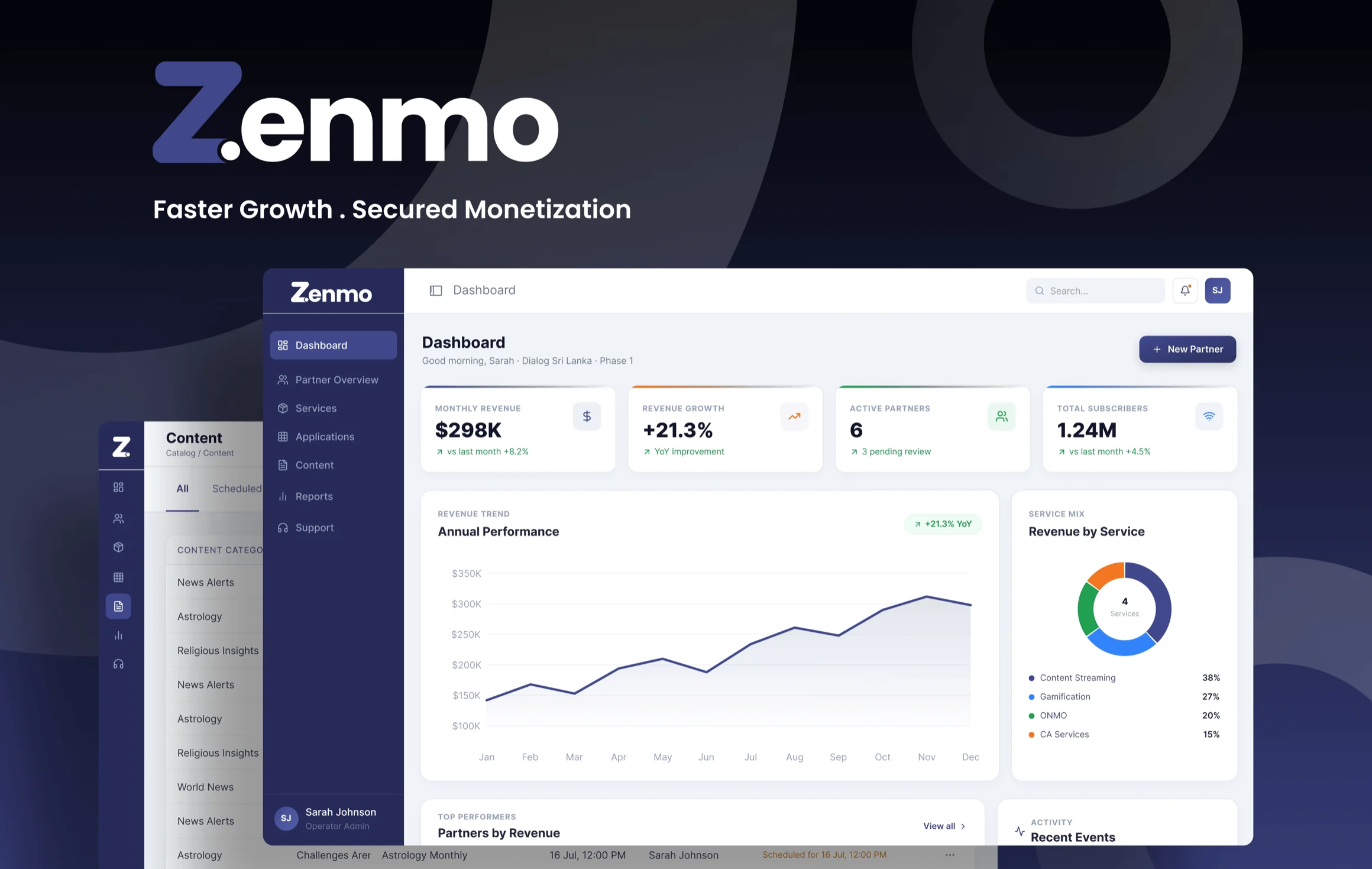
One dashboard. Every VAS service.
Telecom operators running VAS ecosystems had no single source of truth. Operators were buying multiple services, each on its own platform, with content, reports, and billing all managed separately. Tracking anything meant jumping between tools.
As a solo designer, I owned it from discovery to dev handoff. Zenmo is an MVP, currently in its first operator rollout with Dialog Sri Lanka signed off and Etisalat Qatar in active discussions.
Challenge
The cost of a fragmented stack.
Before designing a single screen, we spoke to 6 to 7 telecom operators to find where the pain actually was. Three problems came up every time:
Scattered content
Every service had its own platform and its own rules. What worked in one didn't carry to the next.
Reports meant grunt work
To see how a service was doing, operators pulled numbers from several tools and pieced the picture together themselves.
Billing never matched
Revenue came from multiple providers with no shared ledger, so operators reconciled it by Manually.
Design Decisions
Built in the order operators needed it most.
Phase one was an MVP, so the first decision was scope: the smallest set of modules that could actually run an operator. We locked on to 8 modules enough to onboard a partner, upload content, and see the numbers in one place.
Partner Onboarding
Came first onboarding, nothing downstream works until partners exist. The problem: a lot of information to collect, plus manual verification before going live.
A 4-step wizard broke it up, ending in a review summary. After submission, a Pending Verification timeline showed operators exactly where they stood, making the wait transparent rather than a black box.
Content Upload
Providers dealt with wildly different content: music, games, video, news, each with its own fields. A separate form per type wouldn't scale.
One upload interface, two modes: Single adapts its fields to the content type; Bulk handles scale with clear progress and error states.
Reports
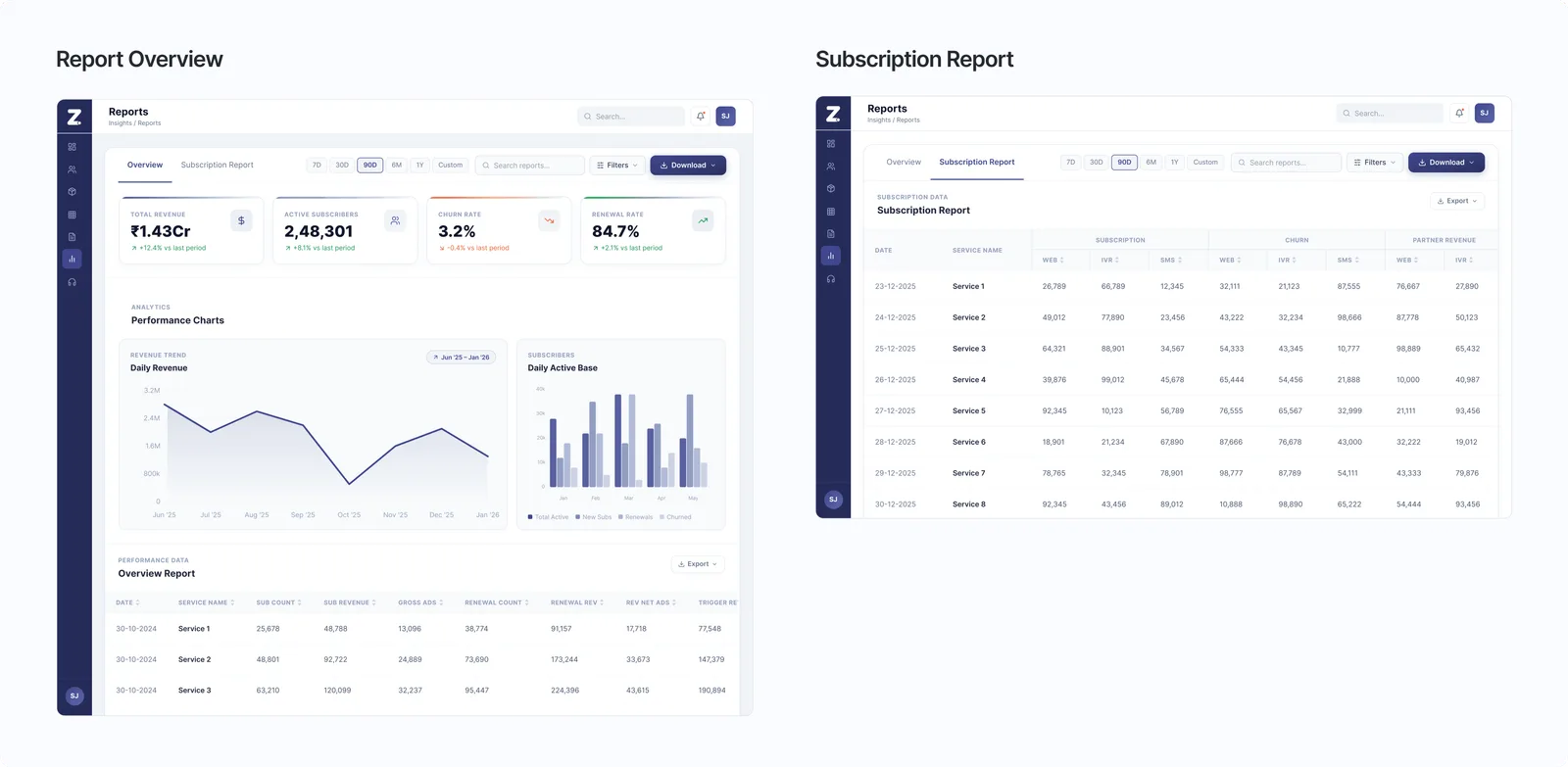
The most direct answer to fragmentation. Everything operators used to gather by hand is now in one place, filterable and exportable: revenue, active base, subscriptions, partner revenue.
Two tabs: Overview for the big picture, Subscription Report for the detail.
Impact
The fragmentation tax, repaid.
With Zenmo live, the manual coordination that used to gate every operator is designed out. Onboarding that ran for weeks now runs in days. The internal team that spent its time stitching platforms together is freed to actually operate. And because everything runs on one platform, adding a new service no longer means bolting on another system. Growth stops being capped by how much manual work an operator can absorb.
5X
Faster Partner Onboarding
10 weeks → 2
40%
Fewer internal issues raised
Vs pre-platform volume
Lower
Cost to onboard each partner
less manual effort per operator
In market
- Dialog Sri Lanka has signed off as the first operator client
- Etisalat Qatar is in active onboarding discussions.
Learning
What a 0-to-1 build in a complex domain taught me.
Generic patterns don't survive a complex domain.
The VAS ecosystem has a depth that standard UX patterns don't account for. There was no template to follow, I had to learn the business before I could design for it.
Building the design system solo, under deadline, was the hardest part.
Owning the system while designing 8 modules meant every component decision rippled across the whole product. I underestimated how much that would slow everything else down.
Next time, I'd start from an existing system.
Building from scratch locked in visual decisions too early. An established base would have freed me to focus on what mattered the product decisions, not the component library.